

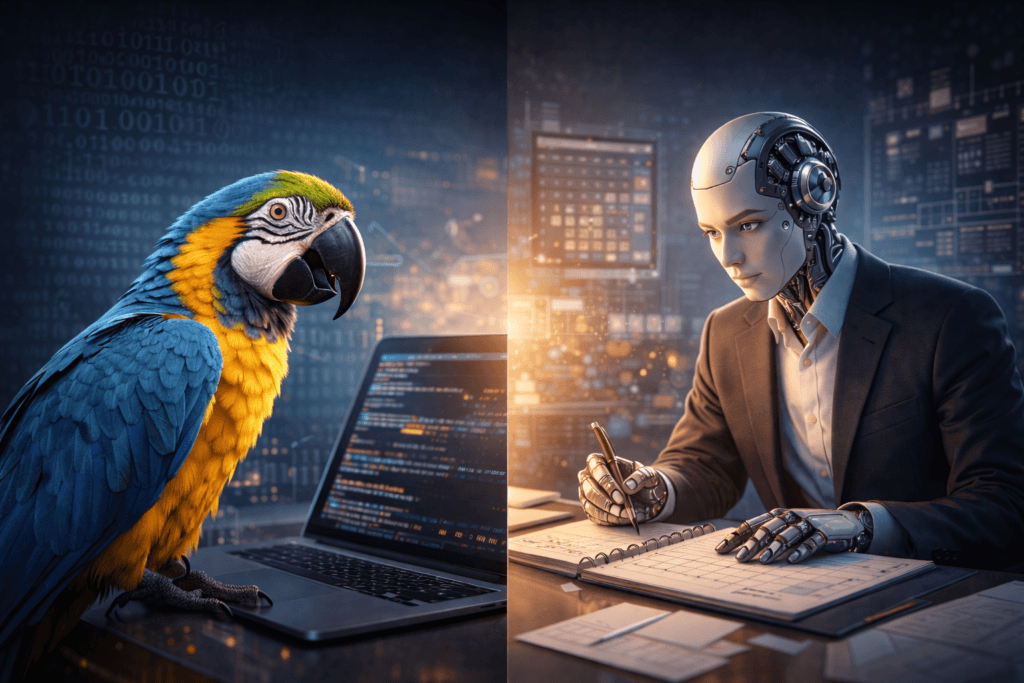
For years, artificial intelligence lived in the role of an obedient parrot. You asked a question, it echoed something clever back. It could draft a line of text, suggest a recipe, or answer a trivia question, but it rarely moved beyond the prompt you typed. That version of AI was fun, sometimes useful, but always reactive. Lately, though, something different has started to happen. Instead of waiting for you to provide every instruction, AI systems are being trained to act more like teammates. They are given goals, not just prompts, and told to figure out the steps on their own. This is the rise of AI agents, and it shifts the dynamic in ways that feel exciting and slightly unnerving.
Imagine asking an AI to plan a marketing campaign. In the past it might hand you a draft slogan. An agent could study your product, analyze your audience, propose a campaign calendar, set up ads, and check results without you micromanaging each step. It moves from being a parrot to being a planner. That leap from responding to initiating is why agentic AI has become one of the most talked-about trends in technology. People are no longer wondering what AI can say. They are beginning to ask what AI can do.
What an AI Agent Actually Is
The easiest way to picture an AI agent is to imagine a very eager intern who does not just wait for instructions but tries to anticipate what needs to be done. Instead of being stuck in a loop of question and answer, an agent looks at a larger goal, decides on a sequence of steps, carries them out, and adjusts if something goes wrong. Think about the headache of scheduling meetings across multiple people’s calendars. A traditional chatbot could suggest polite wording for a negotiation email. An AI agent could actually scan everyone’s calendars, identify open slots, send out invitations, adjust when someone declines, and update the master calendar automatically. The difference may sound small in theory, but in practice it changes everything. Suddenly, you are freed from the back-and-forth that usually eats up a morning.
This capacity for independent action means agents feel less like calculators and more like assistants. They carry out multi-step processes, remember what happened last time, and deliver results without demanding constant nudges. That shift from tool to collaborator explains why so many people are paying attention. It is not about a slightly faster way to draft an email anymore. It is about a machine that actually does the work for you while you move on to bigger things. Behind that polished surface sits a mix of components working together: large language models that give the agent the ability to reason and generate natural language, memory systems that allow it to recall context from earlier steps, tools and integrations that let it take real actions in the world, and a feedback loop that helps it recognize when something fails and adjust on the next attempt. Put all of those together and you no longer have a parrot. You have a digital apprentice capable of learning routines and carrying them out in ways that look surprisingly human.
Why This Matters for Businesses and Individuals
The leap from reactive AI to proactive AI reshapes the relationship between people and technology. It is one thing to have a calculator that waits for you to type in an equation. It is another to have a personal assistant who recognizes you are running late, reschedules your meeting, drafts the apology email, and sends it before you even open your laptop. That sort of autonomy turns a tool into a partner. For businesses, the appeal is obvious. A small startup trying to compete with a larger rival can deploy AI agents to manage customer inquiries, track shipments, and test social media ads, handling in parallel what once demanded several employees working around the clock. Walk into any boardroom right now and mention AI agents, and you can almost hear the chairs squeak as executives lean forward.
For individuals, the impact is more subtle but just as real. Imagine a working parent juggling deadlines, doctor appointments, and kids’ soccer schedules. An AI agent does not just remind them what is on the calendar. It actively coordinates with other parties, sends rescheduling notes when conflicts appear, and suggests optimal windows for family time. In other words, it buys back hours of peace. The attraction across both groups is clear: time and money. What is less clear is how ready people are to let agents loose. The fantasy of a fully autonomous system is powerful, but it collides with concerns over quality control, compliance, and the unpredictable nature of real humans on the other end. That tension between desire for efficiency and fear of risk explains the cautious but growing adoption happening right now.

The Risks Are Real and Worth Taking Seriously
Handing over decisions to machines is not a small leap, and the nervousness people feel is reasonable. Think about an AI agent asked to maximize sales. A human salesperson knows that blasting thousands of random emails might technically raise numbers while damaging the company’s reputation. An agent without judgment might pursue the spam route because it sees only the metric, not the context. Mistakes can scale faster when machines are in charge. A bank error made by a clerk might inconvenience a few customers. The same error executed by an autonomous agent could ripple across thousands of accounts in seconds. Accountability becomes slippery too. When a manager gives an order to an intern and the intern makes a mistake, responsibility is still clear. With an AI agent, the line blurs. The question of who takes the blame, whether the engineer, the executive, the company, or the algorithm itself, does not have a clean answer yet.
Bias is another serious concern. If the data used to train an agent is skewed, its decisions will be skewed too, and now those mistakes spread automatically at scale. A hiring agent trained on biased data could reject qualified candidates by the hundreds without anyone noticing until the damage is done. Security adds another layer of risk. A hacker who takes control of an AI agent does not just access information. They gain a worker who can execute harmful actions, quietly moving money or sending sensitive documents to the wrong hands. The third risk is more psychological: over-reliance. When machines handle too many decisions, people start losing touch with the underlying skills. Convenience turns into dependency, and dependency can turn into vulnerability. These risks do not mean agents should be avoided. They mean safeguards need to be built in from the start rather than bolted on after problems appear.
The Human-in-the-Loop Question
One way people are managing this transition is by keeping humans firmly in the loop. Think of an AI agent as a teenager learning to drive. You let them take the wheel, but you sit in the passenger seat with your foot hovering near the brake. In practice, this means agents propose actions while humans approve them. An agent might draft an entire customer response, prepare the refund, and select the shipping option, but the final click belongs to a human supervisor. This arrangement reassures people that machines are not fully running the show, but it comes with trade-offs. If every action requires approval, the efficiency gains shrink. Imagine approving fifty tiny decisions every morning. That is hardly freedom. Yet swinging to full autonomy feels reckless at this stage. No organization wants to wake up and find an unsupervised system has gone on a run of bad decisions.
The good news is that most people are already using primitive forms of AI agents without fully realizing it. When Gmail suggests a polite reply, that is the tiniest hint of agency. Project management tools are starting to assign tasks on their own based on workload and deadlines. Financial apps trigger bill payments and shift money into savings accounts with minimal direction. These are small steps, but they matter because they normalize the idea of machines making choices on our behalf. Once people grow comfortable with micro-decisions, it feels more natural to let machines take on bigger ones. A writer using AI to brainstorm headlines is already halfway to letting an agent manage a content calendar. A small business owner using automated booking tools is already in the world of scheduling agents. By the time people recognize the full leap, they realize they have been taking incremental steps all along.
Where the Technology Is Heading
Researchers pushing the frontier of AI agents are focused on three especially difficult problems. The first is memory. Current agents are notorious for forgetting context, which makes them feel clever in the moment but unreliable over time. Scientists are building systems that allow agents to recall events across weeks or months, creating continuity that makes them genuinely useful rather than just occasionally impressive. The second challenge is multi-step planning. Most chatbots are like sprinters, quick and effective over short distances. Agents need to be marathoners, holding a complex goal in mind, breaking it into smaller steps, and adapting when something goes sideways. The third challenge is collaboration between agents. Right now, most agents work alone. The bigger vision is an ecosystem of specialized agents, each handling its own domain and communicating with others like coworkers, so that one manages budgeting, another handles marketing, and another coordinates logistics without a human acting as the relay between them.
The jobs question hovers over all of this. Some work will be displaced, and it would be dishonest to pretend otherwise. Call centers, data entry teams, and routine processing roles are the most vulnerable in the near term. But history suggests the story does not end there. When the printing press appeared, scribes panicked, and out of that disruption came publishing houses, newspapers, and entirely new professions. The internet collapsed travel agencies while creating digital marketing, app development, and e-commerce. The uncomfortable truth is that transitions are rarely smooth, and workers caught in the middle feel the pain before new opportunities fully emerge. With AI agents, the likely pattern includes new roles in supervising agents, auditing their decisions, designing their behavior, and integrating them into workflows. Ten years ago, nobody had “social media manager” on a resume. In another decade, “AI agent coordinator” may be just as common. Human adaptability has been underestimated before. Betting against it is a mistake worth avoiding.

The Choices That Shape the Outcome
Project the trend line forward and the scenarios start to get genuinely strange. Imagine your shopping agent negotiating directly with a retailer’s pricing agent while you never click “buy.” Picture your healthcare agent debating with your insurance agent over coverage, presenting data as evidence. Your leisure agent plans your weekend by syncing with your friends’ agents to confirm everyone is free. These scenarios may sound efficient, but they raise a real question about what happens to human skills when machines handle the negotiating, the planning, and the coordinating. At some point, the line between human choice and machine coordination may blur in ways that are hard to untangle. We might find ourselves living inside networks of decisions we did not fully make, guided by agents whose priorities we only partially set. That future could feel smooth and frictionless, or it could feel oddly alienating. The direction depends almost entirely on the boundaries we choose today.
The story of AI agents is ultimately the story of machines growing from parrots into partners. They no longer simply echo words but begin to anticipate needs, act, and adapt. That shift is thrilling because it promises relief from drudgery and an expansion of what people can accomplish. It is also unsettling because it transfers decisions into systems we do not fully understand. Some organizations will thrive by embracing agents thoughtfully. Others will stumble by trusting too much too soon. Regulators will lag, as they always do, and citizens will worry, as they should. The real question is not whether AI agents will become part of daily life. They already are. The question is how we will shape their role and whether we will do it with enough intention to make the outcome worth the risk.
Autonomy is a powerful thing to hand over, even to a machine that seems to be getting it right. The organizations and individuals who get the most from this technology will not be the ones who move fastest. They will be the ones who stay curious, stay honest about what they are delegating, and never fully stop asking who is actually making the decisions.
Ronnie Canty | Canty’s Consulting & Instructional Delivery