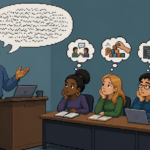

Everyone wants to fix the program. When training falls flat, the first instinct is to rewrite the curriculum, swap out the modules, or bring in a new vendor with shinier slides. Organizations spend thousands of dollars redesigning content that was never the real issue. The content was fine. The delivery was the problem. And until someone is willing to say that out loud, the cycle keeps going.
This is one of the most expensive blind spots in professional development. A well-designed program handed to a weak facilitator produces weak results every single time. But a skilled facilitator working with imperfect material can still move a room, shift thinking, and produce real behavior change. The program is the vehicle. Delivery is the engine. You can have the nicest car on the lot and still go nowhere if the engine is shot.

The Program Gets the Credit It Does Not Deserve
When training works, organizations tend to credit the content. When it fails, they blame the content too. This creates a loop where the curriculum gets rewritten over and over while the facilitation stays exactly the same. Nobody wants to point at the person standing in the front of the room and say the problem is how they are showing up. It is uncomfortable. It is personal. So instead, the slides get a new template and everyone moves on.
Here is what that pattern costs. It costs time, money, and trust. Employees who sit through training that does not land do not just forget the content. They lose faith in the process. After enough rounds of forgettable training, the eye rolls start before the session even opens. That skepticism is not a learner problem. It is a delivery problem that compounded over time until it became a culture problem. And once learners stop believing training is worth their attention, getting it back is a long road.
What Delivery Actually Means
Delivery is not about being a good speaker or having high energy. That is performance, and performance alone does not produce learning. Real instructional delivery is about reading the room, managing the pace, knowing when to slow down because something did not land, and knowing when to push forward because the group is ahead of you. It is the ability to hold a learning environment where people feel safe enough to try, fail, and try again. That is a skill set, and most organizations never formally develop it in their trainers.
Think about the difference between a trainer who reads bullets off a slide and a facilitator who stops mid-session because two participants are quietly disagreeing and turns that tension into the best teaching moment of the day. Same content. Completely different outcome. The second person is not just presenting information. They are managing a learning experience in real time. That requires situational awareness, instructional judgment, and confidence that only comes from intentional practice.

The Facilitator Variable Nobody Measures
Organizations measure everything about training except the thing that matters most. They track completion rates, attendance, post-survey scores, and cost per learner. Almost nobody formally assesses facilitation quality as a variable in training outcomes. That means you can run a program ten times with ten different facilitators and never figure out why results vary so wildly from cohort to cohort. The program looks the same on paper. The delivery was never the same twice.
This is not about blaming facilitators. Most trainers were never taught to facilitate. They were content experts who got handed a slide deck and told to present it. Subject matter expertise and instructional delivery are two completely different skill sets, and organizations routinely assume one implies the other. It does not. Knowing something deeply does not mean you know how to transfer it. Knowing how to transfer it is the whole job.
What Strong Delivery Looks Like in Practice
Strong delivery starts before anyone walks into the room. It means knowing your audience well enough to anticipate where they will resist, where they will zone out, and where the content connects to something they already care about. A skilled facilitator does not just prepare slides. They prepare questions, transitions, checkpoints, and contingency plans for when the planned approach is not working. That level of preparation looks invisible when it works, which is exactly the point.
During a session, strong delivery means presence. Not performance, presence. It means the facilitator is more focused on what the learners are doing than what they themselves are saying. Are people writing things down or are they checking their phones? Is the room quiet because they are thinking or because they are lost? Those signals are data, and responding to them in the moment is what separates a good training experience from a forgettable one. A facilitator who is locked into a script cannot see any of that. They are too busy getting through the deck.

How to Start Fixing the Right Thing
The first step is honest assessment. Not a post-training survey asking whether the coffee was hot. Actual observation of facilitation in action, with clear criteria for what good delivery looks like. That means sitting in on sessions, reviewing recordings, and having direct conversations about facilitation skill as a professional standard rather than a personality trait. This is not about whether someone is naturally charismatic. It is about whether they can hold a learning environment effectively.
From there, the investment goes into facilitator development, not more content redesign. That means coaching, practice sessions, peer observation, and feedback loops that treat delivery as a craft worth developing. It also means rethinking how you select facilitators in the first place. Enthusiasm and content knowledge are not enough. The question should always be whether this person can create the conditions where learning actually happens. If the answer is uncertain, that is the gap to close before the next program launches.
Your training program is probably not the problem. The real question is who is delivering it, how they were prepared, and whether anyone has honestly measured the gap between what they know and what they can actually do in a room full of real people. Fix that first. Everything else will start working better almost immediately.
Canty’s Consulting & Instructional Delivery works with organizations that are serious about closing the gap between knowing and doing. If your training results have plateaued and the content keeps getting redesigned without results, the conversation worth having is about delivery. Reach out at [CCID website URL] to start there.
Ronnie Canty | Canty’s Consulting & Instructional Delivery