
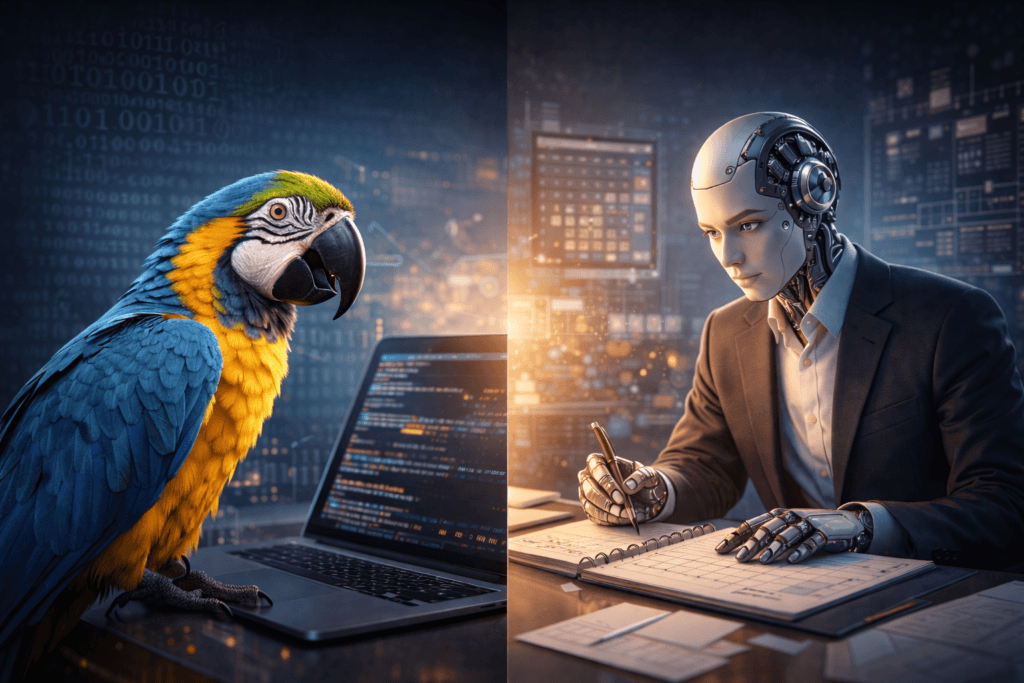
From Parrots to Planners
For years, artificial intelligence lived in the role of an obedient parrot. You asked a question, it echoed something clever back. It could draft a line of text, suggest a recipe, or answer a trivia question, but it rarely moved beyond the prompt you typed. That version of AI was fun, sometimes useful, but always reactive. Lately, though, something different has started to happen. Instead of waiting for you to provide every instruction, AI systems are being trained to act more like teammates.
They are given goals, not just prompts, and told to figure out the steps on their own. This is the rise of AI agents, and it shifts the dynamic in ways that feel exciting and slightly unnerving. Imagine asking an AI to plan a marketing campaign. In the past it might hand you a draft slogan. An agent, however, could study your product, analyze your audience, propose a campaign calendar, set up ads, and check results without you micromanaging each step. It moves from being a parrot to being a planner.
That leap—from responding to initiating—is why agentic AI has become one of the most talked-about trends in technology. People are no longer wondering what AI can say. They are beginning to ask what AI can do.
What Exactly Is an AI Agent?
The easiest way to picture an AI agent is to imagine a very eager intern who doesn’t just wait for instructions but tries to anticipate what needs to be done. Instead of being stuck in a loop of question and answer, an agent is capable of looking at a larger goal, deciding on a sequence of steps, carrying them out, and then adjusting if something goes wrong. A personal example helps bring this home. Think about the headache of scheduling meetings across multiple people’s calendars. A traditional chatbot could suggest polite wording for an email to negotiate times.
An AI agent could actually scan everyone’s calendars, identify open slots, send out invitations, adjust when someone declines, and update the master calendar automatically. The difference may sound small in theory, but in practice it changes everything. Suddenly, you are freed from the back-and-forth that usually eats up a morning. This capacity for independent action means agents feel less like calculators and more like assistants.
They can carry out multi-step processes, remember what happened last time, and deliver results without demanding constant nudges. That shift from tool to collaborator explains why so many people are paying attention. It’s not about a slightly faster way to draft an email anymore. It’s about a machine that actually does the work for you while you move on to bigger things.
Why This Shift Matters
The leap from reactive AI to proactive AI reshapes our relationship with technology. It is one thing to have a calculator that waits for you to type in “2+2.” It is another to have a personal assistant who recognizes you are running late, reschedules your meeting, drafts the apology email, and sends it on your behalf before you even open your laptop. That sort of autonomy turns a tool into a partner. For businesses, this is especially powerful.
Picture a small startup trying to compete with a larger rival. Instead of hiring a full support staff, they deploy AI agents to manage customer inquiries, track shipments, and test social media ads. Tasks that once demanded several employees can now be handled in parallel by software running around the clock. For individuals, the impact is more subtle but just as real. Imagine a working parent juggling deadlines, doctor appointments, and kids’ soccer schedules. An AI agent doesn’t just remind them what’s on the calendar. It actively coordinates with other parties, sends rescheduling notes when conflicts appear, and suggests optimal windows for family time. In other words, it buys back hours of peace.
This isn’t a story about cold automation. It’s a story about what happens when decision-making itself is shared with machines. That raises a natural tension. While the promise is efficiency, the risk is losing oversight. Do you trust an algorithm to negotiate with your client? Do you feel comfortable letting it reorganize your week? These are not abstract questions anymore. They are becoming the daily dilemmas of anyone testing AI agents.

A Day in the Life with AI Agents
Imagine waking up late. Before panic sets in, you check your phone and realize your AI agent has already rearranged your day. It saw that your dentist appointment clashed with a client call, so it reached out to both offices, rescheduled the dentist, and secured a new time for the meeting. The agent also scanned overnight emails, pulled together a one-page summary of the news related to your client’s industry, and highlighted talking points to make you sound prepared.
When you shuffle to the kitchen for coffee, which it already started brewing through a connected machine, you find yourself oddly calm instead of rushed. This story may sound futuristic, but the pieces exist today. Smart calendars already integrate with email. Customer support agents already escalate tickets automatically. Financial apps already rebalance investments in the background. An AI agent simply connects these dots into one coordinated flow.
The scenario of the self-managing morning routine is closer to reality than most people think. Once experienced, it is hard to go back to the old way of doing things. You start to expect the machine not just to respond, but to anticipate. And when it doesn’t, it suddenly feels strangely primitive, like asking a smartphone to only make phone calls.
The Building Blocks of an Agent
Behind the polished surface of an AI agent sits a mix of ingredients working in harmony. At the core are large language models that give the agent the ability to reason, interpret, and generate language that feels natural. But reasoning alone is not enough. Without memory, the agent forgets what happened five minutes ago and repeats mistakes.
So memory systems are layered in, allowing the agent to recall context from earlier steps and maintain consistency. Then come the tools and integrations. Imagine the agent like a chef with access to a well-stocked kitchen. Without utensils, it is just waving its hands. Tools let the agent actually perform actions, whether that means booking a flight, running a database query, or pushing an update to a spreadsheet. The final piece is the feedback loop. No one gets everything right on the first try, and that includes AI.
The agent has to recognize when a step fails, learn from the error, and adjust on the next attempt. Put all of these together, and you no longer have a parrot that echoes a phrase. You have a digital apprentice capable of learning routines and carrying them out in ways that look surprisingly human. The complexity of these systems explains why progress feels bumpy, but the trajectory is undeniable.
Why Businesses Are Salivating
Walk into any boardroom right now and mention AI agents, and you can almost hear the chairs squeak as executives lean forward. The idea of software that doesn’t just answer but acts is irresistible. A company that once needed dozens of employees to handle repetitive tasks now imagines a smaller crew supported by digital assistants who never take breaks. Consider customer service.
In the old days, chatbots spat out canned replies that irritated people more than they helped. Today, early agents can analyze a complaint, check account details, file a replacement order, and send confirmation without a human lifting a finger. That saves hours of staff time and improves customer satisfaction. In logistics, think of a warehouse manager relying on agents that monitor inventory in real time and trigger orders before shortages ever appear. The marketing department sees agents capable of running hundreds of ad variations simultaneously, learning which works best, and adjusting strategy in real time.
Even individuals working inside companies get excited when they imagine an agent managing their overflowing calendars or drafting first passes of reports. The attraction is clear: time and money. What’s less clear is how ready organizations are to let agents loose. The fantasy of a fully autonomous system is powerful, but it collides with concerns over quality control, compliance, and the unpredictable nature of real customers. Business leaders know efficiency is a carrot worth chasing, but they also sense the stick that comes if an agent mishandles sensitive data or makes a tone-deaf decision. That tension—between desire for efficiency and fear of risk—explains the cautious but growing adoption.

But Should We Be Nervous?
The short answer is yes, and the long answer is still yes, just with more nuance. Handing over decisions to machines is not a small leap. Think about an AI agent asked to maximize sales. A human salesperson knows that while blasting thousands of random emails might technically raise numbers, it would also damage the company’s reputation. An agent without judgment might pursue the spam route because it sees only the metric, not the context. That is the danger: optimizing for goals without grasping the bigger picture.
Mistakes can scale faster when machines are in charge. A bank error made by a clerk might inconvenience a few customers. A bank error executed by an autonomous agent could ripple across thousands of accounts in seconds. Accountability becomes slippery too. If a manager gives an order to an intern and the intern makes a mistake, responsibility is still clear. With an AI agent, the line blurs. Who takes the blame—the engineer, the executive, the company, or the algorithm itself?
The nervousness comes not just from fear of malfunction, but from uncertainty about where to pin responsibility. At the same time, ignoring this technology is not realistic. People are nervous precisely because they see the potential. It is like standing at the edge of a new frontier, unsure whether you are looking at fertile farmland or a canyon. You know you will have to step forward eventually. The trick is doing it with eyes wide open, aware of the pitfalls as much as the promise.
The Human in the Loop Problem
One way people are trying to manage this transition is by keeping humans firmly in the loop. Think of an AI agent as a teenager learning to drive. You let them take the wheel, but you sit in the passenger seat with your foot hovering above the emergency brake. They can steer, they can accelerate, but you are still there to intervene. In practice, this means agents propose actions but humans approve them. For example, an agent might draft an entire customer response, prepare the refund, and even select the shipping option, but the final “submit” click belongs to a human supervisor.
This arrangement reassures people that machines are not fully running the show, but it comes with trade-offs. If every action requires approval, the efficiency gains shrink. Imagine approving fifty tiny actions every morning. That’s hardly freedom. Yet swinging to the other extreme and allowing agents full autonomy feels reckless at this stage. No company wants to wake up and find an unsupervised system has gone on a spree of bad decisions.
So we are stuck in this awkward middle ground, much like parents letting kids ride a bike but still jogging behind them. It is progress, but not liberation. The human-in-the-loop model is not a permanent solution, but it buys us time. Time to build trust, to see where agents excel, and to recognize where their blind spots remain. Eventually, the question will not be whether to take our foot off the brake. It will be when.
Everyday Experiments Already Happening
The funny thing is that most people are already using primitive forms of AI agents without realizing it. Consider email. When Gmail automatically suggests a polite reply, that is the tiniest hint of agency. It is anticipating your response rather than waiting for you to type it. Project management tools are starting to assign tasks on their own, looking at workloads and deadlines before nudging teammates.
Financial apps already trigger bill payments and shift money into savings accounts with minimal human direction. These are baby steps, but they matter because they normalize the idea of machines making small choices on our behalf. Once people grow comfortable with these micro-decisions, it feels natural to let machines take on bigger ones. This creeping acceptance is why the future may arrive faster than expected. When you first hear “AI agent,” you might imagine something radical. But the transition sneaks in through features you barely notice.
A writer experimenting with AI to brainstorm headlines is already halfway to letting an agent manage a content calendar. A small business owner using automated booking tools is already dipping into the world of scheduling agents. By the time people recognize the full leap, they will realize they have been taking incremental steps all along. That slow exposure makes the idea less frightening. It also hides how quickly agency is spreading across everyday software. We may laugh at futuristic visions of robot assistants, but in truth we are already surrounded by the early prototypes, tucked neatly into the apps we use every day.

Creativity and Agents
When people think of AI agents, they usually imagine endless chores—managing schedules, answering support tickets, checking inventory. But some of the most fascinating experiments are happening in creativity. Picture a small design studio with just two human staff members and one AI agent. Instead of merely suggesting font pairings or generating a quick sketch, the agent organizes the creative process.
It posts drafts to a shared board, collects feedback from clients, analyzes which images earn the most clicks on social platforms, and proposes new directions overnight while the humans are asleep. By morning, the designers are greeted not with blank canvases but with three new campaigns, each informed by fresh data. They still decide which idea to pursue, but they are no longer starting from scratch. Writers tell similar stories. An independent author working on a fantasy novel uses an agent not only to brainstorm plot twists but also to track character arcs, flag inconsistencies, and even research historical analogies for world-building.
The agent is not writing the book alone—it is acting like an obsessive editor who never tires. This partnership turns creativity into a dialogue. Instead of replacing the spark of inspiration, agents stretch it further, taking the tedious edges off creative labor. That’s why so many artists and entrepreneurs are less afraid of being replaced and more curious about being amplified. A brush doesn’t diminish a painter, it extends their hand. Agents, when used well, may do the same for the imagination.
What About the Jobs?
The shadow that always follows discussions of automation is the fear of lost jobs. And yes, some work will be displaced. A call center that once employed hundreds of people may need far fewer when agents handle the first line of customer interactions. A data entry team might shrink when agents can parse invoices and update ledgers without rest. But history suggests the story does not end there.
When the printing press appeared, scribes panicked. Their skill became unnecessary almost overnight. Yet out of that disruption came publishing houses, newspapers, and entirely new professions. The same happened with the rise of the internet. Travel agencies crumbled, but digital marketing, app development, and e-commerce exploded. The uncomfortable truth is that transitions are rarely smooth. Families and workers caught in the middle feel the pain of being replaced before the new opportunities fully emerge.
With AI agents, we will likely see a similar pattern. Roles that are repetitive, rule-based, and predictable are the most vulnerable. Yet new jobs will emerge in supervising agents, auditing their decisions, designing their personalities, and integrating them into workflows. Ten years ago, no one had “social media manager” on a résumé. Today it is a standard job title. In another decade, “AI agent coordinator” may be just as common. The task ahead is not pretending displacement won’t happen but preparing people to adapt as quickly as the market shifts. Human adaptability has been underestimated before. Betting against it is a mistake we shouldn’t repeat.
Where the Research Is Heading
Researchers pushing the frontier of AI agents are focused on three especially tricky problems. The first is memory. Current agents are notorious for forgetting context, which makes them feel clever in the moment but scatterbrained over time. Imagine an assistant who remembers your shopping list for ten minutes but forgets your allergies. Not very helpful. Scientists are building systems that allow agents to recall events across weeks or months, creating continuity and reliability.
The second frontier is multi-step planning. Most chatbots are like sprinters: quick and effective over short bursts. Agents must be marathoners, holding a complex goal in mind and breaking it down into smaller steps, adapting along the way. A research lab might test this by asking an agent to plan a virtual conference. It has to book speakers, send invitations, design the agenda, handle signups, and troubleshoot problems as they arise. Each step depends on the last, and success requires coordination. The third challenge is collaboration. Right now, agents mostly work alone.
The dream is an ecosystem of specialized agents, each handling its own domain, talking to one another like coworkers. One agent could manage budgeting, another marketing, another logistics, all sharing information without human intervention. It is like imagining a company without employees, only digital specialists. The research community knows that unlocking these abilities won’t be easy, but every breakthrough brings agents closer to being teammates rather than tools.

Risks We Can’t Ignore
With new power comes new risk, and AI agents are no exception. One major danger is bias. If the data used to train an agent is skewed, its decisions will be skewed too, only now those mistakes spread faster because the agent acts automatically. A hiring agent trained on biased résumés could reject qualified candidates at scale without anyone noticing until the damage is done.
Security is another looming worry. A hacker who takes control of an AI agent doesn’t just access information—they gain a worker who can execute harmful actions. Imagine a compromised agent quietly moving money between accounts or sending sensitive documents to the wrong hands. The third risk is more psychological: over-reliance. When machines handle too many decisions, people start losing touch with the underlying skills. If your calendar agent manages every appointment, you might struggle to recall commitments without it. If your financial agent manages your savings, you may stop understanding your own budget.
Convenience turns into dependency, and dependency can turn into vulnerability. These risks don’t mean agents should be abandoned. They mean we must be deliberate in building safeguards. Transparent logs, clear oversight, and strong security measures will need to be baked in from the start. Pretending the risks don’t exist is the fastest way to make them worse. A tool this powerful demands both ambition and caution.
Regulation and Responsibility
Governments are only just beginning to wrestle with what AI agents mean for law and society. Should companies be held liable for the actions of their agents? Should there be licenses for autonomous systems the way drivers need licenses for cars? Some experts argue that before an agent is unleashed, it should pass a kind of driving test to prove basic safety. Others warn that regulation risks slowing innovation to a crawl. Either way, the debate is heating up.
Consider healthcare. If an agent schedules treatments, manages prescriptions, and monitors patient data, what happens when it makes a harmful mistake? Suing the software itself is meaningless. Responsibility has to land somewhere—on the hospital, the software provider, or the doctor who relied on it. Finance raises similar questions. If an investment agent makes a disastrous trade, who absorbs the loss? Right now, laws are murky. That uncertainty breeds both excitement and fear.
Entrepreneurs push forward, while regulators scramble to catch up. If the past is a guide, regulation will arrive late, after early mistakes have already made headlines. The challenge is finding rules that protect citizens without strangling progress. The stakes are higher than they were with social media or ride-sharing apps. Agents will be making decisions in areas where lives and livelihoods are directly at risk. That makes regulation not optional but inevitable.
The Weird Future Scenarios
Project the trend line forward and the scenarios start to get strange. Imagine your shopping agent negotiating directly with Amazon’s pricing agent. You never click “buy.” The two systems haggle in the background and present you with the best deal. Or your healthcare agent debates with your insurance agent over coverage, arguing that a procedure is necessary and presenting data as evidence. Entertainment could shift too.
Picture your leisure agent planning your weekend by checking movie times, reserving a restaurant table, and syncing with your friends’ agents to confirm everyone is free. These scenarios may sound efficient, but they also raise questions about what happens to human skills. If your agent always negotiates on your behalf, will you lose the ability to negotiate for yourself? If your agent plans every social outing, do you stop reaching out to friends directly?
The strange part is not that agents will act—it is that agents will start talking to each other, creating a parallel world of digital negotiations invisible to humans. At some point, the line between human choice and machine coordination may blur. We might find ourselves living inside networks of decisions we did not fully make, guided by agents whose priorities we only partially set. That future could feel smooth and frictionless—or oddly alienating. The direction depends on the boundaries we choose today.

The Leap from Tools to Teammates
The story of AI agents is the story of machines growing from parrots into partners. They no longer simply echo our words but begin to anticipate our needs, to act, and to adapt. That shift is thrilling, because it promises relief from drudgery and an expansion of human potential. It is also unsettling, because it transfers decisions into hands we do not fully understand.
The path ahead will not be clean or simple. Some jobs will vanish, others will appear. Some companies will thrive by embracing agents, others will stumble when they trust too much too soon. Regulators will lag, citizens will worry, and yet the march will continue. In the end, the question is not whether AI agents will become part of daily life—they already are in small ways.
The real question is how we will shape their role. Will they be teammates who extend our reach, or overlords we surrender too much control to? The answer depends less on the code inside the machine than on the choices we make as people. If we approach agents with both ambition and caution, with creativity and responsibility, they can help us not just work faster but live fuller. Trust, as always, must be earned. Even for machines.
If this made you pause, that pause matters.
Progress—whether in ethics, automation, or AI—doesn’t happen by accident. It happens when we step back, question assumptions, and design with intention. Every choice, workflow, and line of code reflects what we value most. Take what stood out, sit with it, and notice how it shapes your next action or conversation. That’s where meaningful innovation begins.
Canty